
The Quiet Reset Nobody in DLP Is Talking About Loudly Enough
For two decades, Data Loss Prevention sold the same promise: define what your sensitive data looks like, watch every channel it could escape through, and block it on the way out. Regex for credit card numbers. Fingerprints of design documents. Keyword lists for project names. The vendor logos changed. The model did not.
That model is now breaking in public, and two of the most credible voices in the analyst world have said so within weeks of each other.
Gartner's Market Guide for Data Loss Prevention (April 2025) opens with a line that, for anyone who has run a DLP program, lands like a quiet thud:
"DLP is a mature market, but modern organizations are exploring comprehensive solutions that go beyond traditional DLP methods. Security and risk management leaders should focus on user-centric, adaptive risk-based data security techniques to strengthen the security of their organization's data." – Gartner, Market Guide for Data Loss Prevention, April 2025
Software Analyst Cyber Research (SACR) put it less politely in The Great DLP Reset: the legacy DLP model is breaking, not because detection has failed, but because the underlying assumptions no longer hold. Data is no longer in your network. Users are no longer at your endpoints. The destinations are no longer your suppliers, they are AI models that will train on whatever you paste in.
Both reports converge on the same conclusion. The next era of DLP will not be won by better content inspection. It will be won by context: who the user is, what they intend, where the data is going, and whether that destination deserves to receive it.
This post is about that shift, what it actually means in production, and the 14 dimensions of context a modern DLP needs to carry.
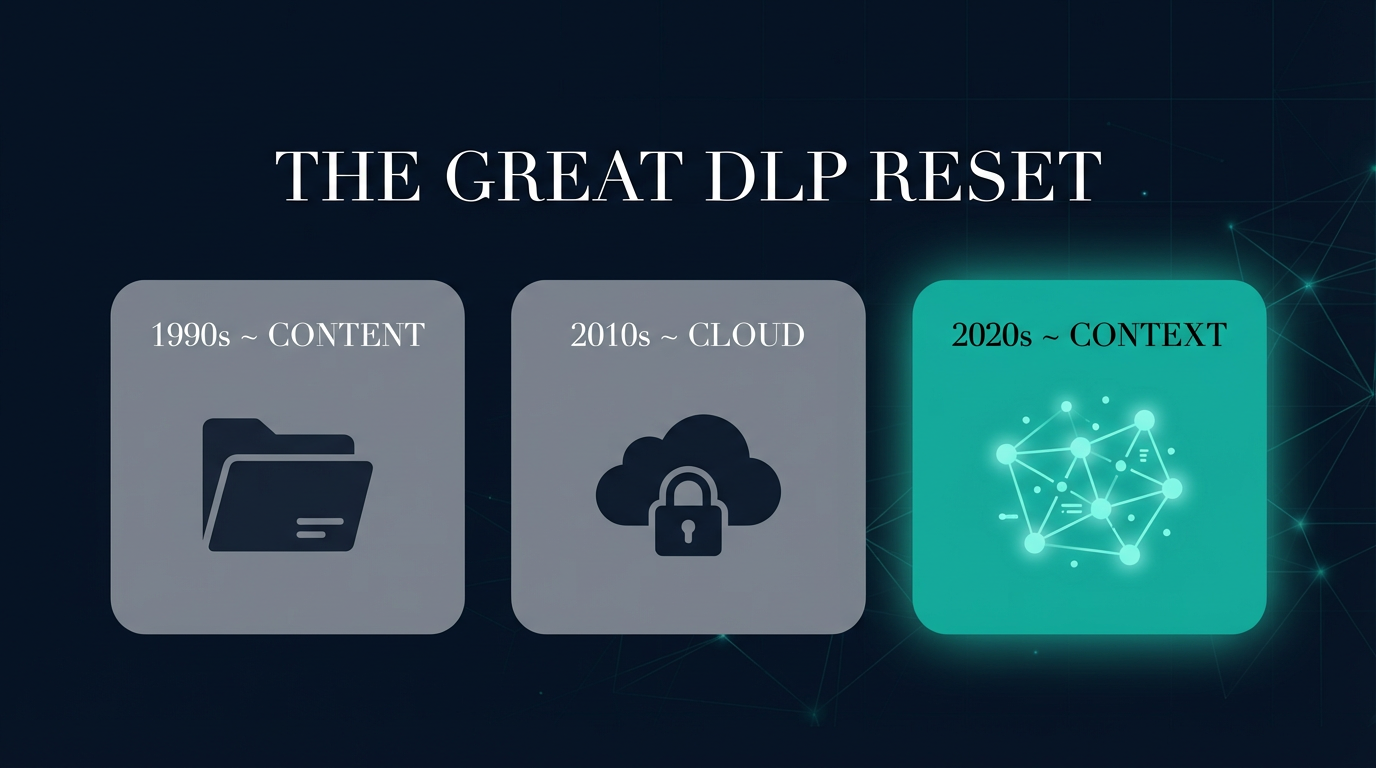
Three Eras of DLP, in One Picture
To see why "context-based DLP" is more than a marketing phrase, it helps to look at how the category got here.
| Era | Dominant question | Where data lived | Primary control |
|---|---|---|---|
| 1990s to mid-2000s. Content DLP. | What is in the file? | File shares, email gateways, endpoints. | Regex, fingerprints, keyword lists. Block at the edge. |
| 2010s. Cloud and channel DLP. | Through which channel did it leave? | SaaS apps, browsers, mobile, API. | CASB, SSE, IDLP modules bolted onto SWG and email. |
| 2020s. Context-based DLP. | Should this user, doing this thing, send this data, to that destination, right now? | AI prompts, autonomous agents, third-party SaaS, on-device. | Real-time decisions enriched by identity, intent, vendor trust, agent trust and behavior. |
The first two eras still matter. PII patterns and channel coverage are table stakes. But neither answers the question that defines the AI era: is the recipient of this paste safe? A regex cannot tell you that. A fingerprint cannot tell you that. Only context can.
What Gartner and SACR Are Actually Saying
The two reports were written by different teams with different methodologies, and yet they read like a coordinated brief.
That single number reframes the buyer conversation. Insider risk and DLP are no longer separate budgets. They merge, because the controls only work when they share user context: identity, role, baseline behavior, anomalies and intent.
Gartner is even more direct about where detection is heading:
"Solutions with adaptive risk-based DLP often leverage UEBA and UAM to supplement or replace data detection. These solutions can analyze user activities, communication patterns and other contextual information derived from user activity to detect anomalous deviations from normal behavior and establish user intent." – Gartner, Market Guide for Data Loss Prevention, April 2025
"Supplement or replace data detection." That is not a footnote. That is the analyst telling buyers that content inspection alone is no longer the spine of the product. Behavior, identity and intent are.
SACR gets to the same place from a different angle:
"The next era of DLP will be a discovery-led data control plane combining truth, context, distributed enforcement, remediation and evidence." – Software Analyst Cyber Research, The Great DLP Reset, April 2026
Strip the framing and the message is the same: the product that wins the next decade will be a control plane, not a content scanner. Truth and context feed it, distributed enforcement points act on it, remediation closes the loop, evidence keeps it auditable.
The Context Stack: 14 Dimensions a Modern DLP Needs
If context is the new spine of DLP, what does the spine look like? The strongest products in the next two years will fuse the following dimensions into every block, warn or allow decision. Not all at once, and not all from the same vendor. But the more of the stack a product covers natively, the fewer integrations and policy gaps the buyer inherits.
| # | Context dimension | What it answers |
|---|---|---|
| 1 | Vendor and destination trust (TPRM) | Is the receiving party trustworthy? |
| 2 | Vendor data-handling commitments | Will they train on it, share it, retain it? |
| 3 | Identity | Who is sending the data, in what role? |
| 4 | Entitlements | Are they supposed to have access at all? |
| 5 | Sharing and exposure posture | Is this Drive folder already public? |
| 6 | Data sensitivity classification | Is it PII, PHI, source code, M&A? |
| 7 | Data lineage and provenance | Where did this content originate? |
| 8 | AI runtime context | Which model, training opt-in, enterprise tier? |
| 9 | Agent trust | Is the autonomous agent on the other side reputable? |
| 10 | Behavioral context | Is this normal for this user, at this hour? |
| 11 | Device posture | Managed, agent installed, TLS inspection on? |
| 12 | Approval and workflow | Is there an open approval that changes the answer? |
| 13 | Geographic and jurisdictional | Cross-border, GDPR, data residency? |
| 14 | Time and recency | Was the vendor approved 6 months ago and never re-evaluated? |
Most legacy DLP products carry one to three of these natively. They bolt on the rest with integrations, which is exactly why policies feel brittle and false positives stay high. The reset Gartner and SACR describe is essentially the migration from "content plus a few hooks" to "content plus most of this stack, evaluated in real time."
Why TPRM Is the Most Underused Context in DLP Today
Of the 14 dimensions, one is conspicuously missing from almost every legacy DLP product: vendor and destination trust. This is striking because it is the cheapest decisive context to act on.
Consider the question a DLP engine asks when an employee pastes a customer list into a chat box. Legacy DLP can answer "this looks like PII." It cannot answer "this is going to a model that trains on free-tier inputs and has no DPA on file." Vendor trust answers that in milliseconds. The block reason becomes specific. The override path becomes auditable. The suggested alternative becomes actionable: "Use the enterprise tier of the same vendor, which is approved, retains nothing, and has a signed DPA."
Vendor trust also collapses one of the most painful classification problems in DLP. Instead of trying to perfectly label every byte of data, the engine can ask the more tractable question: is this destination trustworthy enough for this category of data? Get the destination right, and the data classification problem shrinks.
This is why we keep saying that TPRM is not a sidecar feature. It is a first-class context source for any modern DLP. Treat it that way and policies stop being blunt regex; they start being intelligent decisions a security analyst would actually make.
Account-Aware DLP: The Prosumer Trap, and the Fix
ChatGPT, Claude, Cursor, Gamma, and Napkin are prosumer: the same domain hosts both a sanctioned enterprise tier and a personal tier. Unlike Oracle, Salesforce, or Workday, which were enterprise-only on a domain, today's AI tools mix corporate and personal accounts on a single URL. That breaks the entire static block/allow-list model. Block chatgpt.com and you kill the corporate workflow your finance team just paid for. Allow it and personal logins leak the same data unseen. Legacy DLP forces a bad binary because it cannot see the auth state.
If vendor trust is the most underused destination signal, session persona (which account the employee is signed in with) is the most underused identity signal. The same employee, on the same laptop, opening the same ChatGPT, Claude, Gamma, Napkin, or Cursor URL, can be operating in two completely different risk worlds: a corporate tenant with a signed DPA, zero training, and audit logs, or a personal free-tier account with the opposite of all three.
Legacy DLP cannot tell those two sessions apart. The bytes on the wire look identical. As a result, the dominant Shadow AI exfil path in 2026 is not employees discovering exotic tools. It is employees signing into the AI tools you already approved, but with their personal account, on the corporate device.
Account-Aware DLP closes that gap. The enforcement layer inspects the active session, classifies it as corporate (federated SSO, managed tenant, allow-listed domain) or personal (consumer Google, Apple ID, free-tier email), and then applies the right policy: allow corporate sessions on approved vendors, block egress on personal sessions, and coach the employee toward the corporate login. This is the single capability that CISO and exec-team buyers consistently rank as their #1 ask, because it neutralizes the dominant Shadow AI risk without banning the tools employees rely on.
What Adaptive, Context-Based Enforcement Looks Like
Gartner is explicit that the action layer is changing too:
"Technical controls have become less binary and shifted toward approaches that enable business outcomes instead of halting them completely." – Gartner, Market Guide for Data Loss Prevention, April 2025
The translation, in product terms, is a graduated response ladder driven by context:
- Allow silently when the destination is approved, the user is in role, the data is non-sensitive and the behavior is normal.
- Warn with a reason when one or two context signals are amber. The user sees why and continues.
- Require justification when sensitivity is high but the destination is plausibly trusted. Logged, attributable, audit-ready.
- Suggest a safer alternative when an equivalent approved vendor exists. The block becomes a productivity assist.
- Hard block with appeal only when the combined risk is genuinely high. The appeal opens an approval workflow rather than dead-ending the user.
Each rung is a different policy decision based on the same underlying context. Done well, the user feels enabled, not policed, and the security team gets a richer signal than a binary pass/fail event.
The Real Test: Five Questions to Put to Any DLP Vendor in 2026
If you are evaluating DLP this year (or renewing), these five questions separate context-based products from re-skinned content engines.
- Show me a block decision that uses at least three of the 14 context dimensions above. If it is "PII regex matched," that is one dimension.
- How does your product know whether the destination AI model trains on free-tier inputs? If the answer is "the customer maintains a list," it is not a context engine.
- When you suggest an alternative vendor in the block reason, where does the suggestion come from? A static map is not vendor intelligence.
- What share of your detections is content-only versus context-enriched? If they cannot tell you, the spine has not moved.
- Where does intent live in your data model? Gartner predicts a one-third reduction in insider risk for products that get this right by 2027. It needs to be a first-class field, not an inferred tag.
Where RRR Sits in the Reset
We did not build RRR as a DLP product. We built it as a vendor-trust engine, because the market told us procurement was the wrong place to start a vendor-risk conversation. The browser was. The prompt box was. The agent endpoint was. What we ended up with, almost by accident of the architecture, is exactly the shape Gartner and SACR are describing: a context-based control plane where vendor trust is a first-class signal, not a future integration. The 14 dimensions above are not a wishlist for us, they are a coverage map.
Coverage map: the 14 dimensions, in production today
| # | Dimension | Where RRR carries it | Coverage |
|---|---|---|---|
| 1 | Vendor and destination trust | TPRM Risk Engine + public trust graph | Native |
| 2 | Vendor data-handling commitments | AI Vendor Discovery + Data Intelligence + AI Domain Registry | Native |
| 3 | Identity | Google / Microsoft SSO + Enterprise Policy Sync | Via integration |
| 4 | Entitlements | User Access Reviews | Native |
| 5 | Sharing and exposure posture | Shadow Discovery | Native |
| 6 | Data sensitivity classification | Browser DLP + OS Agent DLP scanners (deterministic + on-device SLM) | Native |
| 7 | Data lineage and provenance | Upload Telemetry + Network Destination Cache | Native (partial) |
| 8 | AI runtime context | AI Domain Registry (model, training opt-in, enterprise tier) | Native |
| 9 | Agent trust | Agent Trust Scoring + RRR MCP Server | Native |
| 10 | Behavioral context | Absence-of-Signal detection + UAR access inference | Native (partial) |
| 11 | Device posture | OS Agent fleet + Browser Extension policy sync | Native |
| 12 | Approval and workflow | Decision Engine + Approval Workflows | Native |
| 13 | Geographic and jurisdictional | Inferred from vendor record + SSO claims | Via integration |
| 14 | Time and recency | Risk Trends + auto re-analysis cron | Native |
Native: shipped, owned by RRR. Native (partial): covers a subset of the dimension, with the rest on the roadmap. Via integration: read from a connected source (SSO, MDM) rather than produced by us. We would rather show partial coverage than overclaim.
Three pieces worth pulling out of the table
Most of the rows above are table stakes for anyone who has been building in this space. Three are not, and they are the ones that change buyer questions from "do you do DLP?" to "how does your control plane think?":
- AI Domain Registry is the live answer to buyer question #2 ("does this destination model train on free-tier inputs?"). RRR maintains a global registry of AI service domains with model identity, training opt-in flags and enterprise-tier markers, refreshed continuously. The policy engine reads it directly, so the customer never has to maintain a list of "AI vendors" or guess which tier of ChatGPT a paste is going to.
- On-device SLM handles the cases where a regex would over-block and a cloud LLM would over-share. The OS Agent runs a small language model locally to do semantic ambiguity reduction: is this paragraph actually PHI, or a Wikipedia excerpt about a disease? Is this code an internal API key, or a public example from a tutorial? The SLM is invoked only when deterministic detectors are uncertain, output is constrained-structured, and the content being judged never leaves the device. That makes context-aware classification cheap enough to run on every paste and upload, without the privacy tax of shipping the content to a cloud judge.
- MCP Server is dimension 9 made operational. Agent-to-agent trust matters because by 2026 the recipient of your data is increasingly another agent, not a human at a SaaS app. RRR exposes its trust signals over MCP so the agent on the other side can verify the agent on this side before accepting work. It is the only enforcement surface that survives once browsers and APIs collapse into the same symmetric channel.
None of these were on the legacy DLP roadmap. All three are now context primitives the next era of products will have to carry, one way or another. We carry them today.
"Old-school DLP knows what your data is. The next era knows where it is going, who runs that destination, and whether you should trust them. That is the reset."
See Agentic DLP in Action
Install the RRR browser extension and watch a real vendor-trust check fire on the next AI tool you visit. No procurement form. No surveillance. Just context, where the decision actually happens.
Get the Browser Extension📖 Go deeper on the TPRM context layer
For the full architecture of how vendor trust feeds DLP decisions in real time, see the deep-dive: Browser Extension vs OS Agent: Closing the Visibility Gap. And the operating model side in Bypasses Are Not a Team Sport.
Closing
The DLP market does not get reset every year. The last time was the move to cloud, and the products that missed it (or treated it as a feature, not a category shift) lost a decade. Gartner has now put a name on the next reset. SACR has put a deadline on it. The buyers will follow.
If you are building, buying or running a DLP program in 2026, the question is no longer "how good is your content engine?" It is: how much context can your control plane carry, and how fast can it act on it?
That is the reset. And it is already underway.
Sources and Further Reading
- Gartner, Market Guide for Data Loss Prevention, April 2025 (analyst reprint, gated).
- Software Analyst Cyber Research (SACR), The Great DLP Reset: Securing Data in the AI Era, April 2026.
Gartner and Market Guide are registered trademarks of Gartner, Inc. and/or its affiliates. All rights reserved. Gartner does not endorse any vendor, product or service depicted in its research publications and does not advise technology users to select only those vendors with the highest ratings or other designation. Statements of fact in this article attributed to Gartner are quoted from the cited Gartner Market Guide.